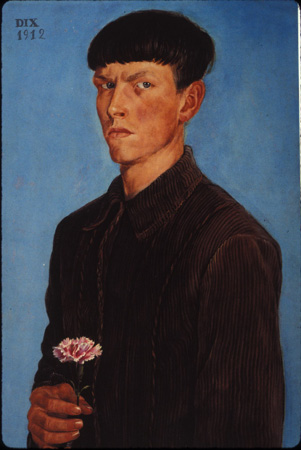
Self-Portrait with Carnation
Year: 1912
Description:
At twenty-two, a young Albrecht Dürer painted a Self-portrait with a thistle (Selbstportrait mit Distel [1493, Louvre]) He probably executed the work as a gift to his new fiancée. At twenty-one, Dix extended a nod in the master's direction when he painted himself in a similar motif.
In this painting we see an incredibly confident young man. Dix didn't just emulate an Old Master. He depicted himself as an Old Master. There are many established artists who would never consider doing such a thing, let alone doing it at aged 21.
Yet as we watch his career unfold, we're left to wonder just how much self-confidence Dix really possessed. As you scroll through this exhibition you'll find that he has a tendency to treat his human subjects in a most unflattering fashion; he accentuates their negative qualities as he downplays their good ones. Yet his own self-portraits never received such treatment. Dix always presents himself in the finest manner.
Provenance: Public Museum
- Institute of the Arts, Detroit, USA
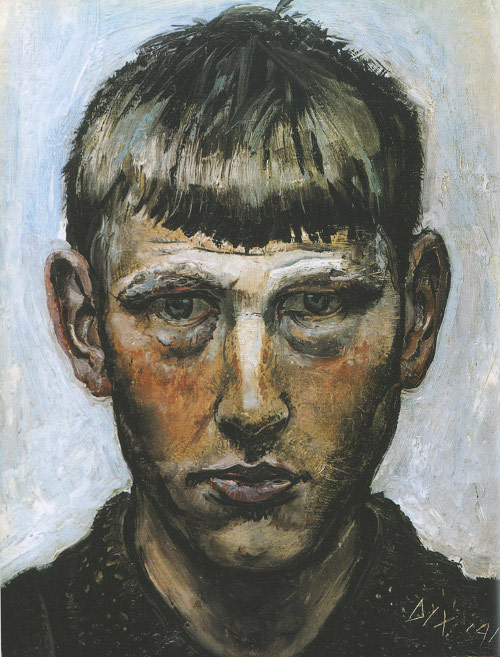
Self-portrait
Year: 1913
Description: Dix was never one to flatter his sitters. The subject's worst features often became the focus of the piece. The same scrutiny was never applied when he turned the easel on himself. Dix was always the most manly man in the room.
In this self portrait from 1913, Dix's likeness is emphasized against a light background. There is no distration, his likeness is the focal point. Aggressive strokes and earth tones suggest strength and manliness. His neutral expression and rosy cheeks provide a hint of vulnerability which suggest a calculated attempt to make points with the ladies.
Provenance:

Sunrise
Year: 1913
Description: Before the war, Dix was an amateur artist working in Dresden. In 1912, the city was home to a major exhibition of the works of Van Gogh. As Sunrise reveals, the young Dix was influenced by the Dutch artist.
In 1920, Dix donated Sunrise (Sonnenaufgang) to the city museum in Dresden. When the NSDAP came to power, they deemed it offensive and had it removed. The work was in private hands after the war.
In 2013, four German cultural foundations pooled resources and purchased the painting at auction in order to donate it to the Städtische Galerie.
Provenance: St�dtische Galerie Dresden
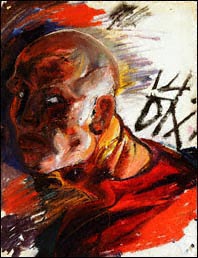
Self-portrait as a Soldier
Selbstbildnis als Soldat
Year: 1914
Description:
In the first year of war, Dix painted himself twice on one piece of paper. On this side, he is depicted in hellish combat with red and white flashes and eyes wide open.
Provenance: Municipal Gallery, Stuttgart, Germany
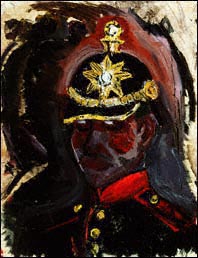
Self-portrait with a Gunner's Helmet
Selbstbildnis mit Artillerie-Helm
Year: 1914
Description:
The other side of the piece above. A worried Dix is pictured in darkness in stark contrast with the gold insignia on his uniform.
Provenance: Municipal Gallery, Stuttgart
Self-portrait as Mars
Selbstbildnis mit Artillerie-Helm
Year: 1915
Description:
In the second year of war, he depcits himself as the God of War with angles borrowed from cubism. In this scene, death is abundant. Horses rear and flee. Buildings burst open and cities crumble. Yet Dix remains alive. Survival under such circumstances might give anyone a messiah complex.
Provenance: Municipal Gallery, Stuttgart
The Foundry
Year: 1919
Description:
The Foundry was hot and the air was foul but it supported the family. Otto's father toiled there for most of his life. Its bricks are dark from soot and its yard is filled with scrap, yet through the Dixian filter, the Foundry is quite attractive.
Provenance: Otto Dix Foundation
Vadux, Germany
The Skat Players
Year: 1920
Description: The war has left them crippled and deformed but their capacity to play skat remains in tact. It is a three-handed card game favored by the Krupps, German manufacturers of the types of weapons that misfigured men such as these.
Provenance: Staatsgalerie, Stuttgart
Prager Straße
Year: 1920
Description: Along Prague Street, deformed men beg for money and attention. A woman in a tight pink dress has no time for them. The Nationalists do. Beside one veteran is a pamphlet entitled, "Jews Out!" The Nazis were not yet a National movement but one of their basic tenets was beginning to disseminate.
Provenance: Staatsgalerie, Stuttgart
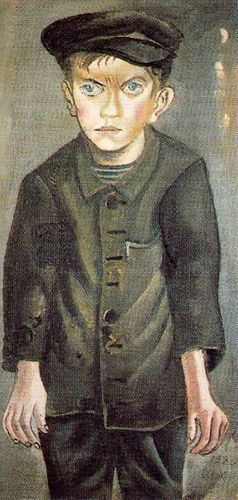
Working Class Boy
Year: 1920
Description: Dix often depicted the lives of the downtrodden. Here we have a chance to see the start of the cycle. The working class boy is anything but carefree. He is overburdened and robbed of youth. His gaze is split as though he's trapped between worlds. He leads the life of an adult although he is just a child. He would like to play but there are mouths to feed. The left eye, the serious eye, steers him toward work.
Provenance: Neue Galerie
-
Björn Sjöling
-
http://radarman1946.tumblr.com/ Melvin
-
Alice Rohr
-
Richard Foran
-
Richard Foran
-
Richard von Bitter
-
Karl Gauss